Computational electromagnetics
Shape derivatives, reduced-basis methods, reliability analysis, and diffraction-efficiency optimization for optical devices.
Computational photonics for energy systems
Theoretical and numerical modeling of photonic, nanophotonic, and electromagnetic systems for smart energy control, thermophotovoltaics, radiative cooling, and advanced optical components.
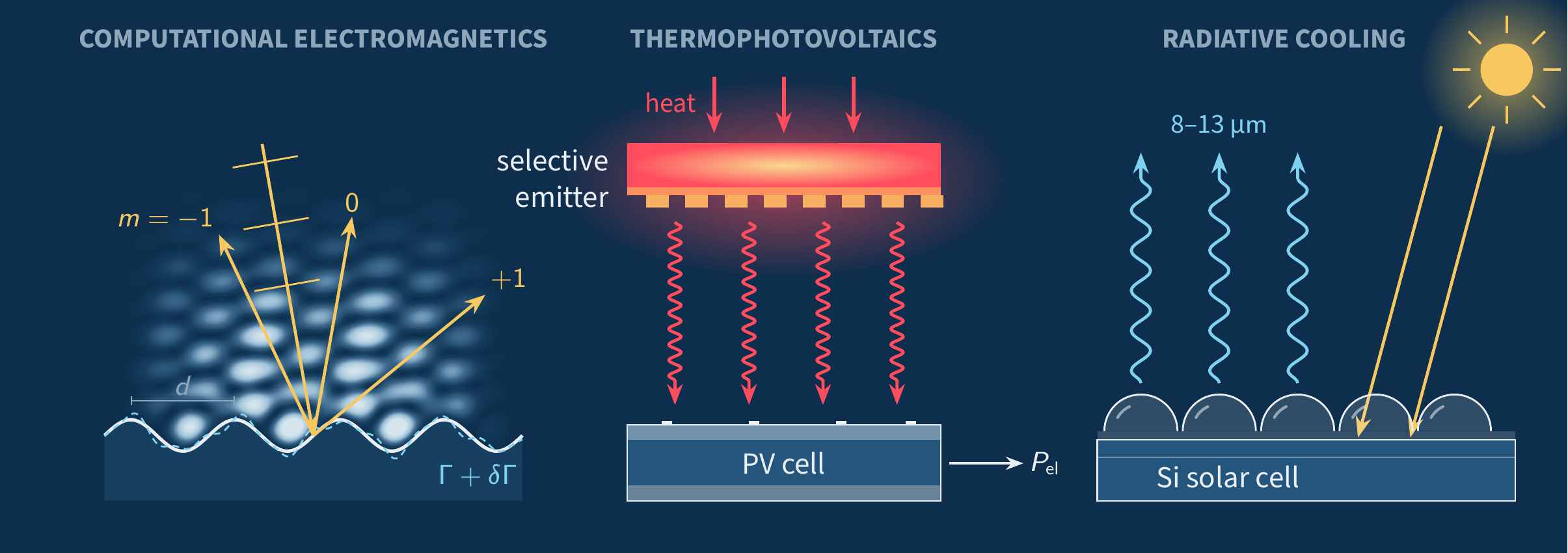
We model, optimize, and quantify uncertainty in optical structures where geometry, materials, and radiation physics determine energy performance.
Shape derivatives, reduced-basis methods, reliability analysis, and diffraction-efficiency optimization for optical devices.
Selective thermal emitters and photovoltaic components designed to improve infrared-to-electricity conversion.
Photonic structures for passive thermal management of photovoltaic cells and energy technologies. Radiative cooling calculator
Current position
Faculty of Science, Engineering and Technology.
The group conducts theoretical and numerical research in optics and semiconductor physics, with applications in radiative cooling, photo- and thermophotovoltaic energy conversion, light-matter interaction modeling, computational electromagnetics, and uncertainty quantification.
Recent work from the publication record. The research page contains the fuller list and project context.